
Some comparisons are easier to make than others. Taylor ham vs. pork roll? New Jerseyans have opinions. The Turnpike or the Parkway? Your destination usually settles that one. Fix-on-Six vs. All-on-4 takes a little more thought. Both treatments replace a full arch of teeth with a fixed, implant-supported restoration, but they use different types and numbers of implants to get there. At Diana Rodriguez & Associates in Union City, NJ, we consider what those numbers don’t reveal about your treatment.
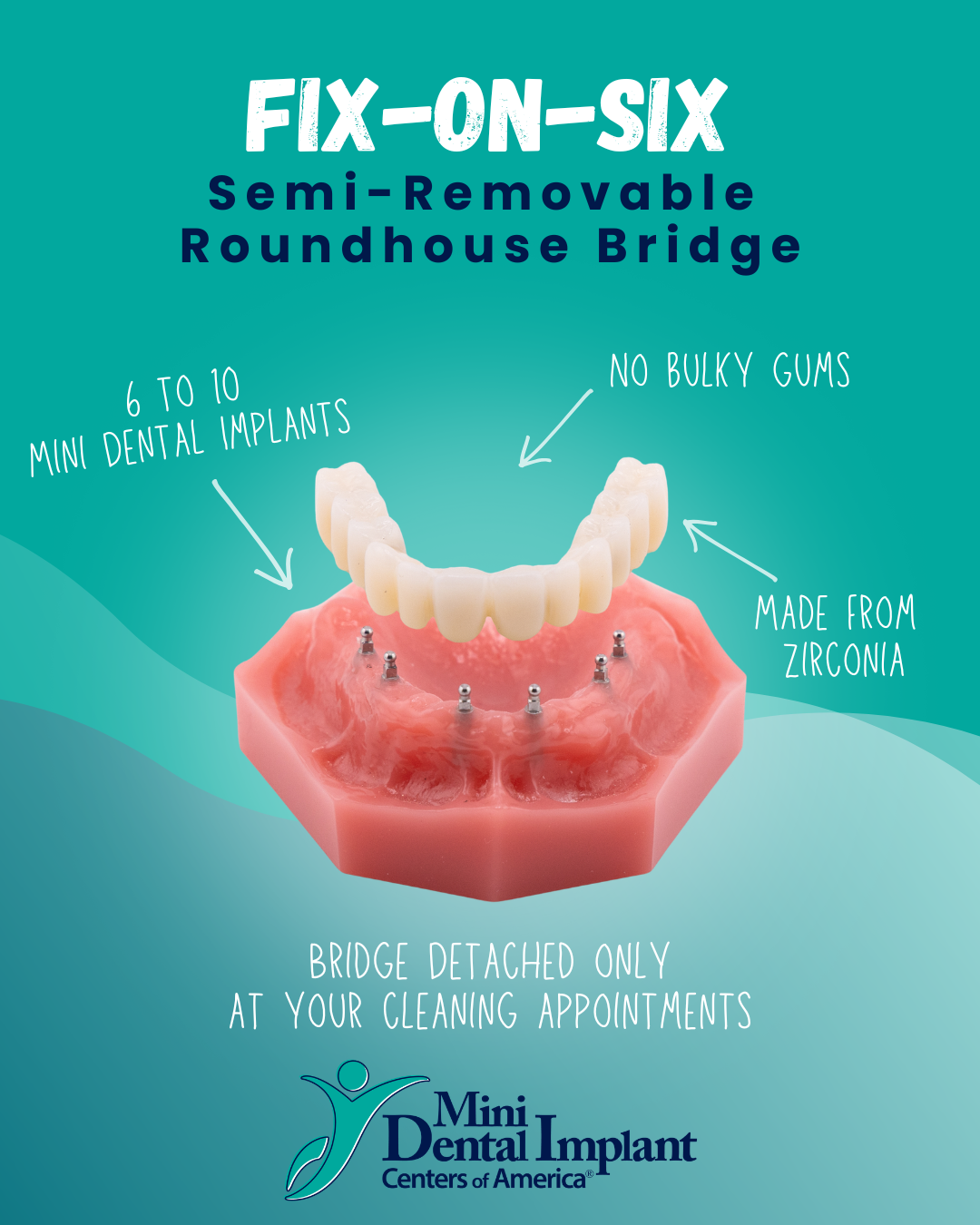
Fix-on-Six uses multiple narrow-diameter mini dental implants, while All-on-4 uses four larger traditional implants. The size difference can affect how we use the available bone, how involved treatment may be, and which patients qualify for full-arch replacement. So, before deciding whether four implants sound better than six, consider a more useful question: Which approach works with where you are in your tooth replacement journey?
Fix-on-Six vs. All-on-4: How Are They Different?
| Feature | Fix-on-Six® | All-on-4® |
|---|---|---|
| Primary approach | A full-arch fixed “roundhouse” bridge supported by mini dental implants | A full-arch fixed “roundhouse” bridge supported by traditional implants |
| Number of implants | An average of 6 to 10 mini dental implants | 4 traditional implants |
| Implant placement | Multiple mini implants placed across the arch to stabilize the bridge | Two straight implants in front; two posterior implants typically angled up to 45° |
| Removability | Fixed in place; not removed at home | Fixed in place; not removed at home |
| What to ask your implant dentist | “Can I get Fix-on-Six if I have bone loss?” | “Can I qualify for All-on-4 without bone grafting?” |
Fix-on-Six and All-on-4 use dental implants of different diameters, and that difference affects how we plan full-arch treatment. Mini dental implants typically measure less than 3 millimeters wide, and traditional implants are closer to 5 millimeters. Fix-on-Six uses several smaller implants across the arch. All-on-4 uses four larger traditional implants.
Implant diameter affects how much room we need within the jaw. A wider implant requires more bone around it for placement. If bone volume is limited, a traditional implant may require additional preparation before we can place it.
Mini implants require less width within the jaw. In some cases, that allows us to use the existing bone without first rebuilding the area with a bone graft. We can then place multiple mini implants across the arch to support the Fix-on-Six restoration.
The implant count alone does not tell you how extensive treatment will be. Six or more mini implants can require less space in the jaw than four larger traditional implants. The more useful comparison is how each implant system fits the available bone and supports the final restoration.
Fix-on-Six vs. All-on-4: Which am I Eligible for?
Before we talk about eligibility for Fix-on-Six or All-on-4, think about where you are right now. Are you trying to save failing teeth? Have you already lost most of your teeth? Have you worn dentures for years?
The answer gives us a starting point. Teeth, bone, and tooth loss are closely connected, so your dental history can tell us a lot about what may be happening beneath the gums.
If you still have failing teeth, for example, some of the bone that once supported them may still be available for implants. We need to account for which teeth require extraction, the condition of the surrounding bone, and where we can position implants as we plan your new teeth.
So, where you are in your tooth replacement journey can tell us where to begin. From there, we can determine what your jaw can support and what we may need to address to make full-arch tooth replacement possible.
How Fix-on-Six Can Expand Eligibility
For some patients, Fix-on-Six opens possibilities that may be harder to achieve with larger traditional implants.
Three differences are especially important:
- Bone loss: Mini implants require less space within the jaw. Patients with a narrow ridge or reduced bone volume may still have enough bone for mini implant placement, sometimes without first rebuilding the area through bone grafting
- Surgical complexity: The smaller diameter of mini implants often allows for a less invasive placement approach. Avoiding grafting or other preparatory procedures can also simplify the path from missing teeth to a fixed restoration.
- Cost: A less complex treatment plan can affect the overall investment. When we can reduce the need for additional procedures, Fix-on-Six may provide a more accessible route to fixed full-arch teeth.
Explore Your Options for Full Arch Replacement: Book a FREE Consultation Today!
A lot can happen between losing a tooth and deciding you want fixed teeth.
At Diana Rodriguez & Associates, we can look at where you are now and determine what your bone can support. For some patients, the smaller size of mini dental implants makes Fix-on-Six possible without the additional procedures they expected. For others, a different full-arch approach may make more sense.
If bone loss, surgery, or cost has kept fixed teeth out of reach, it may be worth finding out what is possible now. Contact our Union City, NJ, office to book a free consultation.