A dental implant needs enough healthy bone to support it. But what happens when the area where a tooth needs to be replaced doesn’t have enough? Sometimes, the bone has gradually shrunk after a tooth was lost or extracted. Advanced gum disease can damage the bone that once supported your teeth, while an infection or injury may leave less bone available for an implant. In other cases, the jawbone may naturally be too narrow, or the position of the sinus may limit the available space. When we say there isn’t enough bone for a dental implant, we usually mean the height or width of the bone at the planned implant site. A bone graft is one way we can address that limitation. By adding grafting material to the area, we can help rebuild the bone needed to support a dental implant.
What Happens During a Dental Bone Graft?
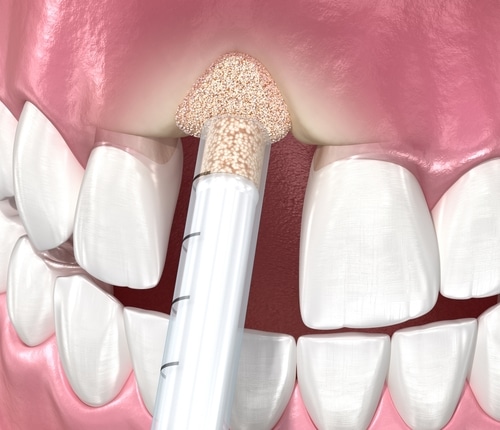
During a dental bone graft, we place grafting material in an area of your jaw that needs additional bone. The material acts as a scaffold, giving your body a structure on which to build new bone. Your body can produce bone tissue, but it needs the right conditions to do that. The graft helps create those conditions by filling the space where bone is missing and providing a framework for new bone to grow into.
We begin by numbing the area with local anesthesia. Once you’re comfortable, we make a small incision in your gums and gently move the tissue aside to reach the underlying bone. We then prepare the area and place the grafting material where additional bone is needed. Finally, we reposition your gums and close the incision with stitches.
Why Your Implant Timeline May Include a Waiting Period
Your gums and jawbone heal at different rates. After a bone graft, you may experience some swelling, tenderness, or discomfort for several days. Your gum tissue generally heals within a few weeks, but the work happening inside your jaw takes considerably longer. Depending on the size and location of the graft, this process can take several months.
How does that affect when we can place your dental implant? There are two possible approaches.
- Placing the bone graft first: If we need to rebuild a significant amount of bone, we typically allow the grafted area to heal before placing an implant. During this time, new bone develops and strengthens the area. We use follow-up examinations and imaging to evaluate how well the graft has healed and determine when the site is ready.
- Placing the bone graft and implant together: In some cases, we can place an implant and add grafting material around it during the same appointment. For this approach to work, you must already have enough natural bone to hold the implant securely in place.
Even when we place the graft and implant together, the implant still needs time to integrate with the surrounding bone. We call this process osseointegration. During this process, a stable connection forms, allowing the implant to support a replacement tooth. Depending on the treatment plan, we may attach a temporary restoration during healing or wait until the implant is ready for its final restoration.
Do You Always Need a Bone Graft Before Dental Implants?
Not necessarily. Mini dental implants measure less than 3 millimeters in diameter, making them considerably narrower than traditional dental implants. Their smaller size can give us more flexibility when working with limited bone. An area that cannot accommodate a traditional implant may still have enough bone to support a mini implant without grafting.
Of course, width is only one consideration. We also need to evaluate the height and quality of your jawbone, where each implant will be placed, and what type of replacement teeth it needs to support. A smaller implant may help us work with the bone you already have, but grafting may still be necessary in some situations.
As a Mini Dental Implant Center of America in Union City, NJ, we have specific training in the planning and placement of mini dental implants. We use that training to evaluate your available bone and determine how we can securely support your replacement teeth, including whether you need a bone graft.
Explore Your Dental Implant Options in Union City, NJ
If you’ve been told you need a bone graft before receiving dental implants, we’d like to take a closer look. At Diana Rodriguez & Associates in Union City, NJ, we evaluate your jawbone, discuss your tooth replacement needs, and explore the implant options available to you. You may have more choices than you were initially given.
Contact us today to schedule a free consultation and find out what your treatment could involve.