

How much difference can the roof of a denture really make? Researchers recently put that question to the test. In a 2025 clinical study, participants wore two versions of an upper implant denture: one that covered the palate and one that left it exposed. When researchers measured how participants ate solid food, they found that palateless dentures required fewer chewing cycles and swallows and less total time to finish the food. There is an important reason why palatal coverage deserves this kind of attention. Your tongue and palate work together as you chew, organize food, and prepare to swallow. An upper denture that covers the palate sits directly over an area involved in those functions. In the study, roughly 85% of participants ultimately chose to keep the denture without palatal coverage.
Palateless dentures use dental implants for support, which makes it possible to leave the roof of the mouth uncovered. For someone accustomed to a traditional upper denture, the difference is easy to see. But the research suggests there is more to consider than how much material has been removed. When a denture no longer has to rely on the palate for support, an entire part of the mouth that was once covered can remain exposed and participate naturally in everyday functions like eating.
How Does the Palate Help Keep Dentures Secure?
Upper and lower dentures both replace a full arch of teeth. But they face different challenges when it comes to staying secure. A traditional lower denture has a smaller area to rest on and must remain stable around the movements of your tongue, cheeks, and the floor of your mouth. An upper denture has a different surface to work with: the roof of your mouth.
A traditional full upper denture has a plate which extends across the palate. The broad coverage helps create the suction and seal that contribute to retention. It also spreads the forces of chewing across a larger area instead of concentrating them along the ridge where your teeth once were. Without adequate palatal coverage, a conventional upper denture can lose much of the retention that keeps it from dropping or shifting as you eat and speak.
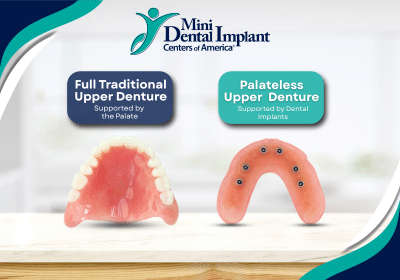
In other words, the palate serves a purpose in conventional denture design. The interesting question is what happens when an upper denture no longer has to depend on that surface to stay secure. Dental implants introduce another source of support and retention, making it possible to remove some or all of the material covering the roof of the mouth.
How Do Palateless Dentures Stay in Place?
A palateless denture still requires support and retention, but dental implants redirect where that support comes from. The denture connects to dental implants we place in the upper jaw, which hold it securely in place.
With implant support, the denture does not have to depend as heavily on the palate for retention. The acrylic that traditionally extends across the roof of the mouth can then be reduced or removed, creating the open, horseshoe shape of a palateless denture.
A palateless denture depends on implant support, which raises another consideration: what does it take to place those implants? Mini dental implants are less than 3 millimeters in diameter, considerably narrower than conventional implants. Their smaller size can be especially useful when the jaw has lost bone after years of missing teeth or denture wear.
We often place mini implants through a small pilot opening in the gums and bone. Many patients can receive them without the incisions, stitches, or bone grafting that may accompany conventional implant treatment. For someone who has worn an upper denture for years, this can provide a more direct path to the implant support required for a palateless design.
Diana Rodriguez & Associates is a designated Mini Dental Implant Center of America in Union City. We use mini implants to stabilize dentures because their size and placement technique expand options for patients who want greater denture stability without a more extensive implant procedure.
Is It Time To Consider Palateless Dentures?
If you wear an upper denture, you know how it feels and functions throughout your day. We would like to hear about your experience.
At Diana Rodriguez & Associates, we can take a closer look at your current denture. We will evaluate your bone structure and the options mini dental implants may offer you. A palateless denture may be one of them. Schedule a free consultation at Diana Rodriguez & Associates and come talk with us about what you would like from your denture.